 Share
Share
Many Large Energy Consumers (LECs) are still taking a “wait-and-see” approach to the Energy Efficiency and Conservation Act (EECA). Others are preparing; but only to meet the minimum compliance requirements.
What concerns us more is that many organizations expect existing facility, energy, or ESG personnel to shoulder EECA responsibilities without additional resources, support, authority, or incentives.
This is a missed opportunity.
At OPTIMISE’s nationwide EECA & EnMS capacity-building programmes [click here],
we emphasize on leveraging EECA as a catalyst for business transformation.
Companies that engage OPTIMISE view EECA as more than a compliance obligation. They leverage it as a catalyst for operational excellence, cost optimization, competitive advantage, and long-term sustainability. At the centre of this transformation is a competent Registered Energy Manager (REM).
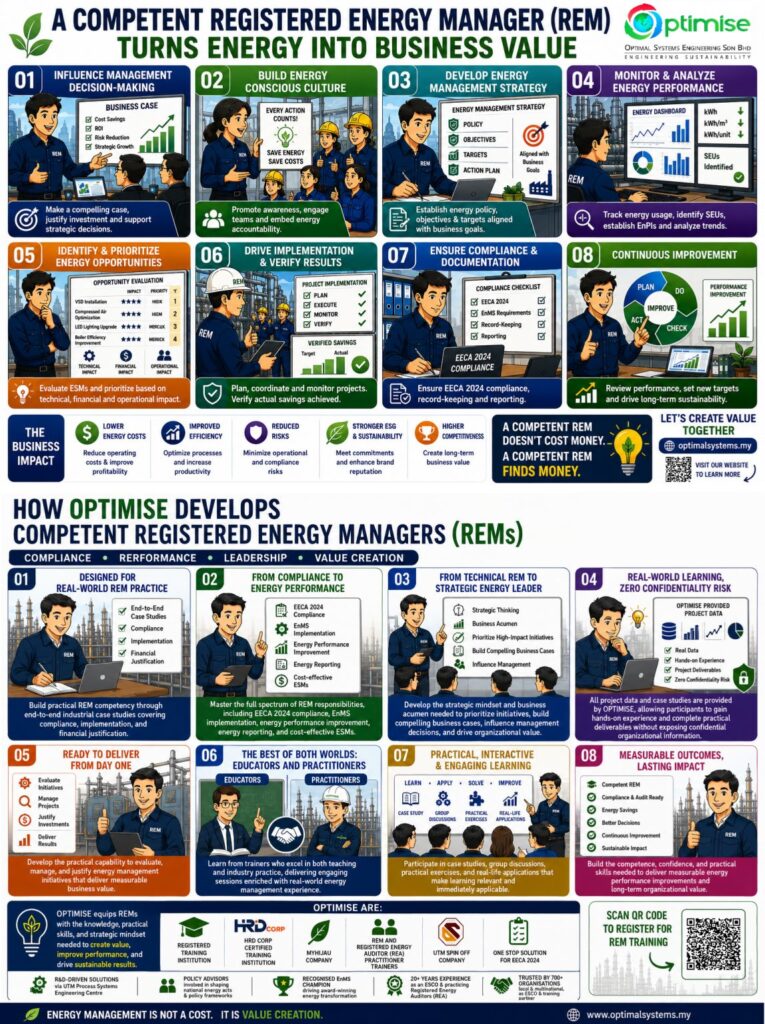
A competent REM does far more than submit reports and monitor utility bills. A competent REM can:
✅ Guide Management Decisions with Data-Driven Business Cases
A competent REM translates energy data into actionable business insights. By quantifying costs, savings, payback periods, and operational impacts, the REM enables management to make informed investment decisions that balance financial returns with energy performance improvements.
✅ Build an Energy-Conscious Culture Across the Organization
Sustainable energy performance cannot be achieved by one individual alone. A competent REM engages employees at all levels, promotes awareness, encourages ownership, and fosters a culture where energy efficiency becomes part of everyday decision-making and operational practices.
✅ Develop Energy Strategies Aligned with Business Goals
Energy management is most effective when it supports organizational objectives. A competent REM develops strategies that align energy initiatives with business priorities such as cost optimization, productivity improvement, sustainability commitments, and long-term growth.
✅ Identify and Prioritize High-Impact Energy Opportunities
Not all energy-saving opportunities deliver equal value. A competent REM systematically evaluates potential initiatives and prioritizes those with the greatest impact on energy performance, operational efficiency, and financial returns.
✅ Drive Implementation and Verify Actual Savings Achieved
Identifying opportunities is only the beginning. A competent REM works with relevant teams to implement energy-saving measures, track progress, and verify that projected savings are actually realized and sustained over time.
✅ Monitor Performance Through EnPIs, SEUs, and Analytics
Effective energy management relies on measurement and analysis. A competent REM establishes meaningful Energy Performance Indicators (EnPIs), monitors Significant Energy Uses (SEUs), and leverages data analytics to identify trends, opportunities, and emerging issues.
✅ Ensure Compliance While Reducing Operational Risks
Beyond meeting EECA requirements, a competent REM helps organizations strengthen governance, improve documentation, enhance operational discipline, and reduce risks associated with energy waste, non-compliance, and inefficient processes.
✅ Lead Continuous Improvement and Long-Term Sustainability
Energy management is an ongoing journey rather than a one-time project. A competent REM drives continuous improvement by regularly reviewing performance, identifying new opportunities, and embedding sustainability into organizational practices and decision-making.
The Result?
💰 Lower Energy Costs
Systematic energy management reduces waste, improves resource utilization, and delivers measurable cost savings that directly strengthen the organization’s bottom line.
⚙️ Improved Operational Efficiency
Energy-efficient operations often lead to better process control, improved equipment performance, reduced downtime, and higher overall productivity.
🛡️ Reduced Business and Compliance Risks
Strong energy management practices help organizations stay compliant, improve operational resilience, and minimize risks associated with rising energy costs and regulatory requirements.
🌱 Stronger ESG Performance
Effective energy management contributes to environmental goals, supports sustainability reporting, and strengthens the organization’s ESG credentials among customers, investors, and stakeholders.
🏆 Higher Competitiveness and Profitability
Organizations that manage energy strategically gain a competitive advantage through lower operating costs, stronger sustainability performance, and improved financial outcomes.
EECA is not merely about compliance. It is about building organizational capability to transform energy management into a strategic driver of business performance and sustainable growth.