
 Share
Share
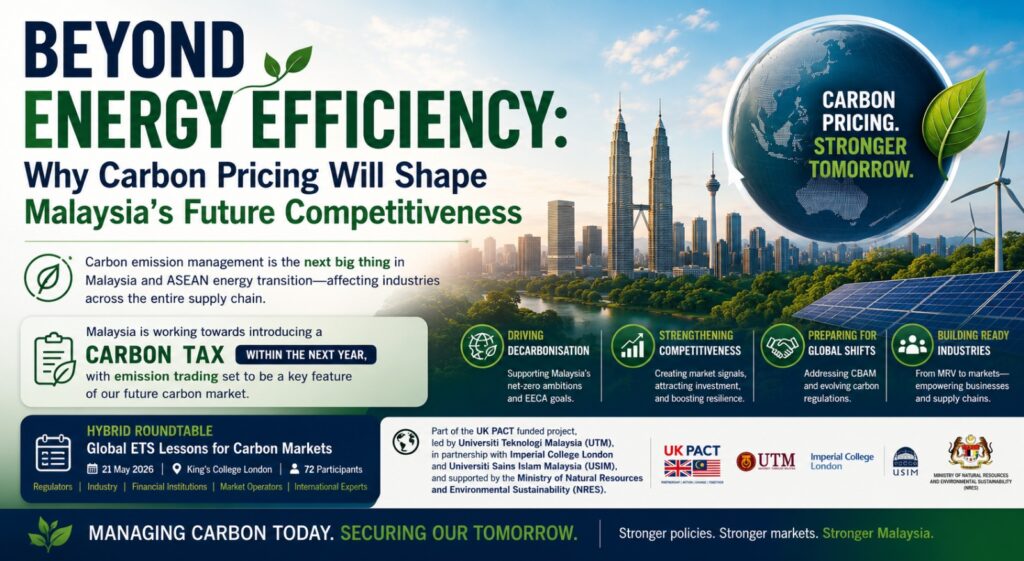
As Malaysia advances its energy transition agenda, carbon emissions management is rapidly emerging as the next major frontier of industrial competitiveness. While energy efficiency and renewable energy have traditionally focused on large energy consumers and major emitters, the growing global shift towards carbon pricing means that carbon management will increasingly influence entire supply chains, affecting manufacturers, exporters, financial institutions, logistics providers, and supporting industries alike.
With carbon regulations expanding globally and trading partners introducing measures such as the European Union’s Carbon Border Adjustment Mechanism (CBAM), businesses are facing growing pressure to measure, report, and manage their carbon footprint. Against this backdrop, Malaysia has begun laying the groundwork for a future carbon pricing framework and is expected to introduce a carbon tax within the coming year. Carbon trading mechanisms are anticipated to play a central role in this transition, creating new market signals, investment opportunities, and compliance pathways for industry while supporting national decarbonisation objectives under the Energy Efficiency and Conservation Act (EECA) and broader net-zero ambitions.
Recognising the strategic importance of these developments, a high-level hybrid roundtable on Global ETS Lessons for Carbon Markets was held on 21 May 2026 at King’s College London under a UK PACT- supported international project led by Universiti Teknologi Malaysia (UTM), in collaboration with Imperial College London and Universiti Sains Islam Malaysia (USIM), with support from the Ministry of Natural Resources and Environmental Sustainability (NRES). The event brought together 72 participants from government, industry, financial institutions, market operators and international experts to examine how established emissions trading systems (ETS) can inform Malaysia’s readiness for a future Domestic Emissions Trading System (DETS).
The roundtable featured regulators and market practitioners from the UK ETS, the European Commission, the European Energy Exchange (EEX), Energy UK and AFME, alongside Malaysian representatives from NRES, Bursa Malaysia, PETRONAS, industry associations and advisory organisations. Discussions focused on practical lessons from mature carbon markets, including regulated-entity readiness, market confidence and investment signals, capital market participation, carbon market liquidity, and the implications of CBAM for export-oriented industries.
A key message emerging from the dialogue was that successful carbon markets require more than technical policy design. They depend on coordinated action across regulators, industry, financial institutions and market operators, supported by robust monitoring, reporting and verification (MRV) systems, clear policy direction and strong institutional readiness. As Malaysia progresses towards carbon pricing and a future DETS framework, understanding how established carbon markets operate in practice will be critical to ensuring a smooth transition that safeguards competitiveness while accelerating decarbonisation.
The roundtable will contribute to a forthcoming policy report that distils international lessons and translates them into practical recommendations to support Malaysia’s carbon market development and long-term energy transition strategy.