
 Share
Share
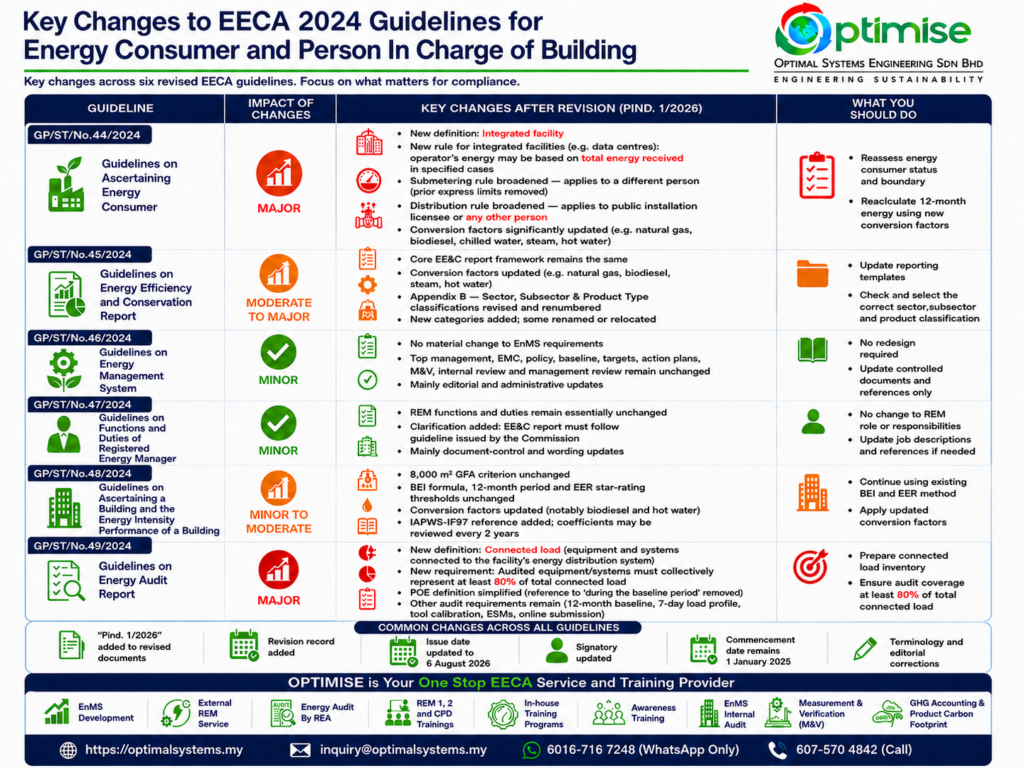
The Energy Commission Malaysia (Suruhanjaya Tenaga) issued its first revision (Pind. 1/2026) on 6 August 2026 for seven key guidelines under the Energy Efficiency and Conservation Act 2024 (Act 861). This article cuts through the complexity to identify the changes that matter most to Energy Consumers and Building Managers, including essential guidance for Registered Energy Managers (REM) and Registered Energy Auditors (REA).
So, what has actually changed?
What should organisations pay attention to?
Below is a brief summary of the key changes in the revised Guidelines.
Guideline Comparison at a Glance
| Guideline | Overall Impact | Key Changes After Revision (Pind. 1/2026) | What You Should Do |
| GP/ST/No.44/2024 – Guidelines on Ascertaining Energy Consumer | 🔴 MAJOR | New definition of Integrated Facility; new treatment for integrated facilities such as data centres where total energy received may be considered in specified circumstances; submetering provision broadened; onward-distribution provision expanded to a public installation licensee or any other person; significant conversion-factor updates | Reassess energy-consumer status and boundary. Recalculate 12-month energy using revised conversion factors |
| GP/ST/No.45/2024 – Guidelines on Energy Efficiency and Conservation Report | 🟠 MODERATE TO MAJOR | Conversion factors updated; Appendix B sector, subsector and product-type classifications revised and renumbered; categories added, renamed or relocated | Update reporting templates. Verify the correct sector, subsector and product classification |
| GP/ST/No.46/2024 – Guidelines on Energy Management System | 🟢 MINOR | No major change to EnMS requirements; mainly editorial and administrative updates | No EnMS redesign required. Update controlled documents and references |
| GP/ST/No.47/2024 – Guidelines on Functions and Duties of Registered Energy Manager | 🟢 MINOR | REM functions and duties remain essentially unchanged; clarification added that the EE&C Report must follow the guideline issued by the Commission; mainly document-control and wording updates | Update relevant references and job descriptions where necessary |
| GP/ST/No.48/2024 – Guidelines on Ascertaining a Building and the Energy Intensity Performance of a Building | 🟠 MINOR TO MODERATE | Conversion factors updated, notably biodiesel and hot water; IAPWS-IF97 reference added; coefficients may be reviewed every two years | Apply the updated conversion factors to applicable calculations |
| GP/ST/No.49/2024 – Guidelines on Energy Audit Report | 🔴 MAJOR | New Connected Load definition; minimum 80% system coverage for audit scope; priority to significant energy-consuming systems; POE definition revised | Establish connected-load inventory, prioritise significant systems and demonstrate ≥80% system coverage |
Rather than discussing every editorial revision, the sections below focus on the changes with the greatest practical implications.
1. A New “Integrated Facility” Concept Could Change Your Energy Consumer Assessment
One of the most significant changes appears in GP/ST/No.44/2024 – Guidelines on Ascertaining Energy Consumers.
Pind. 1/2026 introduces the term “integrated facility”, defined as a facility comprising infrastructure owned, operated and controlled by a person for providing services or operations within the facility.
The revised guideline specifically uses a data centre as an example.
Why does this matter?
The key issue is who owns, operates and controls the energy-consuming infrastructure.
Where the conditions specified under paragraph 6.2.3 apply; including where the operator owns, operates and controls the infrastructure while the tenant or user does not control the operation or efficiency of that infrastructure; the operator’s energy consumption is determined based on the total energy received from the supplier.
This could significantly affect whether an organisation reaches the 21,600 GJ over 12 consecutive months threshold.
Example
| General onward-distribution treatment | Integrated-facility treatment, where 6.2.3 applies | |
| Energy received | 100,000 GJ | 100,000 GJ |
| Energy supplied onward | 80,000 GJ | 80,000 GJ |
| Energy considered | 20,000 GJ | 100,000 GJ |
| ≥21,600 GJ? | No | Yes |
This is an illustrative example only. The actual treatment depends on whether the conditions in paragraph 6.2.3 are satisfied.
The provision is particularly relevant to data centres, where an operator may control central electrical distribution, UPS, cooling and other infrastructure while customers or tenants do not control the operation or efficiency of those systems.
Other multi-user facilities may also need to review their arrangements. However, this does not mean that every shopping mall, commercial building or multi-tenant facility automatically qualifies as an integrated facility. The actual ownership, operational control and energy-distribution arrangement must be considered.
Submetering and onward distribution have also been broadened
The original submetering provision referred to energy supplied to a different person who was not a related corporation and was located within the same compound.
Pind. 1/2026 removes these qualifications and refers more generally to energy supplied through a submeter “to a different person.”
The onward-distribution provision has also expanded. The original provision specifically addressed a public installation licensee, while Pind. 1/2026 refers to a “public installation licensee or any other person.”
What to do?
Organisations with main meters, submeters, tenant energy distribution or centrally controlled infrastructure should reassess their energy boundary and 21,600 GJ determination against the revised provisions.
2. Conversion Factors Have Changed — Check Your GJ Calculation
Several conversion coefficients have been revised or expanded. This matters because these factors are used to convert different energy sources into the common unit of GJ.
Some notable changes in GP/ST 44 include:
| Energy source | Original | Pind. 1/2026 |
| Natural gas | 0.02898 GJ/m³ | 0.047233 GJ/m³ |
| Biodiesel | 27.0 GJ/tonne | 42.4960 GJ/tonne |
| Biodiesel by volume | – | 0.03564 GJ/litre |
| Ethane by mass | – | 47.8 GJ/tonne |
| Chilled water | 0.01266 GJ/RTH | Adds 0.0036 GJ/kWrh |
| Hot water | Mass-based values | Adds volumetric values in GJ/m³ |
The revised values are provided in Appendix A of GP/ST 44.
For organisations using affected energy sources, applying the revised coefficient to the same physical consumption may produce a materially different GJ result.
For example, the natural-gas conversion coefficient has increased substantially. An organisation that was previously below the 21,600 GJ threshold should therefore not assume that its status remains unchanged without recalculating using the latest applicable coefficients.
What to do?
Check EECA assessment spreadsheets, EnMS databases, EE&C reporting templates and energy-audit tools for old or hard-coded conversion factors.
3. EE&C Reporting: Check Your Classification Before the Next Submission
GP/ST/No.45/2024 – Guidelines on Energy Efficiency and Conservation Report contains revisions to both energy conversion factors and Appendix B – Sector, Subsector and Product Types.
The classifications have been revised and renumbered, with some categories added, renamed or relocated.
Examples in the revised appendix include Port Operations and Oil & Gas Terminal, as well as Postal Processing.
This means REMs should not automatically carry forward the classification used in an earlier reporting template.
What to do?
Before preparing the next EE&C Report, recheck:
Sector → Subsector → Product Type → Reporting Unit → Conversion Factor
This is particularly important where an organisation’s activity may now fall under a revised or more specific classification.
4. Building Energy Calculations: Apply the Latest Conversion Factors
For GP/ST/No.48/2024 – Guidelines on Ascertaining a Building and the Energy Intensity Performance of a Building, the changes requiring attention are primarily technical.
The revised guideline updates or expands certain conversion factors, notably for biodiesel and hot water, and introduces a reference to IAPWS-IF97 for relevant steam and hot-water conditions.
The revised guideline also indicates that coefficients may be reviewed every two years.
What to do?
Persons in Charge of Buildings and relevant technical personnel should check that the latest applicable conversion factors are being used in their building energy calculations.
5. Energy Audits: At Least 80% of Total Connected Load Must Be Covered
One of the biggest operational changes appears in GP/ST/No.49/2024 – Guidelines on Energy Audit Report.
Paragraph 4.1.12 requires the equipment or systems audited under paragraphs 4.1.10 and 4.1.11 to collectively represent not less than 80% of the total connected load of the facility, with priority given to systems, equipment or processes that contribute significantly to the facility’s energy consumption.
Suruhanjaya Tenaga has since provided further clarification on how this 80% requirement is to be implemented.
Connected load is treated as a system inventory
For implementation of paragraph 4.1.12, the connected load inventory refers to the list of energy-consuming equipment or systems installed at the facility and connected to the energy supply or energy distribution system.
The facility should first establish its relevant energy-consuming systems. The audit scope should then include not less than 80% of the systems identified in the connected-load inventory.
This means the 80% requirement is based on system coverage.
It is not intended to require electrical and thermal capacities to be mathematically combined using units such as kW, MW, GJ/h, tonnes of steam per hour or other capacity units.
The connected-load inventory may include both electrical and thermal energy-consuming systems.
Example
ST’s clarification provides an industrial-facility example with six systems:
| No. | Energy-Consuming System | Energy Type | Relative Energy Significance |
|---|---|---|---|
| 1 | Lighting System | Electrical | Low |
| 2 | Air-Conditioning System | Electrical | Medium |
| 3 | Compressed Air System | Electrical | High |
| 4 | Boiler / Steam System | Thermal | High |
| 5 | Furnace System | Thermal | High |
| 6 | Production Motor System | Electrical | Very High |
The minimum number of systems is:
6 × 80% = 4.8 systems
Because a fraction of a system cannot be used to determine the minimum scope, the audit must cover at least five out of the six systems.
If five systems are audited:
5 ÷ 6 × 100% = 83.3%
the numerical minimum is achieved.
But the REA cannot simply choose any five systems
This is an important part of ST’s latest clarification.
The 80% requirement must not be applied merely by selecting any 80% of the systems. Systems, equipment or processes that contribute significantly to the facility’s energy consumption must be prioritised.
In ST’s example, the systems that should be prioritised are:
Production Motor System → Furnace System → Boiler / Steam System → Compressed Air System
because they have high or very high energy significance. An additional system can then be added to achieve the minimum five-system coverage.
If the REA excludes the Production Motor System even though it is the largest or one of the most significant energy users and instead selects a less significant system merely to achieve five out of six systems, the audit would not be consistent with the intended prioritisation under paragraph 4.1.12.
How can significance be determined?
ST’s latest clarification provides useful guidance.
The significance of a system may be determined using available information such as:
- existing metering data;
- operating hours;
- equipment capacity;
- process characteristics;
- previous energy-audit information;
- operating records; or
- reasonable engineering estimates.
This approach is also linked to the identification of Significant Energy Use (SEU) under paragraphs 4.1.10 and 4.1.11.
Does every equipment item within an audited system need detailed measurement?
No.
Including a system within the audit scope does not mean every individual item of equipment within that system must be subjected to detailed measurement or data logging.
Where a system contains many similar pieces of equipment, the REA may use representative sampling, where appropriate.
For example:
- an air-conditioning system may comprise several chillers, AHUs and pumps;
- a production motor system may contain many motors of different capacities and operating patterns; and
- a boiler system may contain several boilers of similar design.
Representative equipment may be selected based on factors such as equipment capacity, operating hours, energy significance, operating pattern, equipment similarity and criticality. The basis and justification for the sampling approach should be clearly explained in the Energy Audit Report.
The distinction is therefore:
≥80% system coverage = breadth of audit scope
Representative measurement/sampling = depth of investigation within each audited system
ST summarises the intended process as:
Connected Load Inventory → Identify Significant Energy-Consuming Systems → Prioritise Significant Systems → Include Additional Systems as Necessary → Achieve ≥80% System Coverage → Conduct Appropriate Measurement / Representative Sampling.
What should Energy Consumers and REAs do?
Existing energy-audit procedures and templates should be updated to:
- establish the facility’s connected-load inventory;
- identify the significant energy-consuming systems;
- prioritise those significant systems in the audit scope;
- add other systems until at least 80% system coverage is achieved;
- determine appropriate measurements or representative sampling within each audited system; and
- clearly document the methodology, system selection and sampling justification in the Energy Audit Report.
This latest clarification is particularly important because it removes the need to create an artificial common capacity unit for electrical and thermal systems and makes clear that the 80% requirement is a system-level audit-scope requirement.
6. POE: The Definition Has Been Revised
Another change in GP/ST 49 concerns Percentage of Energy (POE).
In the original guideline, POE referred to the proportion of total energy consumption attributed to each product “during the baseline period.”
In Pind. 1/2026, the words “during the baseline period” have been removed.
| Original | Pind. 1/2026 |
| POE explicitly refers to energy consumption during the baseline period | Reference to the baseline period removed |
The definition is therefore more general. However, the revision does not expressly introduce a new POE calculation formula or methodology.
What to do?
REAs should review existing energy-audit templates and how POE is defined and applied. The revised terminology should be reflected without assuming that an entirely new calculation methodology has been introduced.
What Should Organisations Prioritise?
The revisions do not necessarily require a complete redesign of your EECA compliance system. The priority is to identify which changes affect your organisation and update those areas.
- For Energy Consumers, the key priorities are the energy boundary, integrated-facility treatment, submetering/onward distribution, revised conversion factors and EE&C reporting classifications.
- For Persons in Charge of Buildings, check whether the revised technical conversion factors affect building energy calculations.
- For REMs, review the latest reporting classifications and conversion coefficients before preparing the next EE&C Report.
- For REAs, establish connected-load inventory, identify and prioritise significant energy-consuming systems, demonstrate ≥80% system coverage, and document representative sampling.
- For data centre and facility operators, the new integrated-facility provisions deserve particular attention because the ownership and operational control of infrastructure may directly affect how energy consumption is determined.
When Were These Revisions Issued?
The Pind. 1/2026 documents reviewed in this article are dated 6 August 2026.
The revised documents retain 1 January 2025 as the stated commencement date. They do not state a separate commencement date of 6 August 2026 for the individual revisions.
Organisations should therefore use Pind. 1/2026 as the latest version of the applicable guidelines when reviewing their EECA compliance.
Where the timing of a particular revision could affect a historical assessment, submission or compliance decision, organisations should refer to the official documents and seek clarification from Suruhanjaya Tenaga where necessary.
Refer to Suruhanjaya Tenaga for the Full Requirements
A total of seven guidelines were revised under Pind. 1/2026. This article focuses on the six guidelines reviewed that affect Energy Consumers and Persons in Charge of Buildings and their related compliance activities.
For complete requirements, definitions, conditions, examples, appendices and the full set of revised guidelines, readers should refer directly to Suruhanjaya Tenaga (Energy Commission Malaysia).
Official source: Suruhanjaya Tenaga – www.st.gov.my/eeca
Note: This article is intended as a practical overview. Where there is any difference between this article and the Energy Efficiency and Conservation Act 2024, applicable Regulations or official guidelines issued by Suruhanjaya Tenaga, the official documents take precedence.
Need Help Navigating the Revised EECA 2024 Guidelines?
The revisions are a good opportunity to check whether your organisation’s EECA applicability assessment, EnMS, reporting process and energy-audit methodology remain aligned with the latest requirements.
Optimal Systems Engineering Sdn Bhd (OPTIMISE) is your One Stop EECA 2024 Service and Training Provider, supporting organisations through:
- Energy Management Systems (EnMS) Development
- External Registered Energy Manager (REM) Service
- Energy Audit by Registered Energy Auditor (REA)
- REM 1, 2 & CDP Trainings
- In-house Training Programs
- Awareness Training
- Energy Management Systems (EnMS) Internal Audit
- Measurement & Verification (M&V)
- Greenhouse Gases (GHG) Accounting
- Product Carbon Footprint (PCF)
Whether you need to reassess your 21,600 GJ status, review complex metering or integrated-facility arrangements, update your EE&C reporting, or prepare for the new energy-audit requirements, OPTIMISE can support your organisation in translating the guidelines into practical implementation.
OPTIMISE | Optimal Systems Engineering Sdn Bhd
Engineering Sustainability
www.optimalsystems.my