 Share
Share
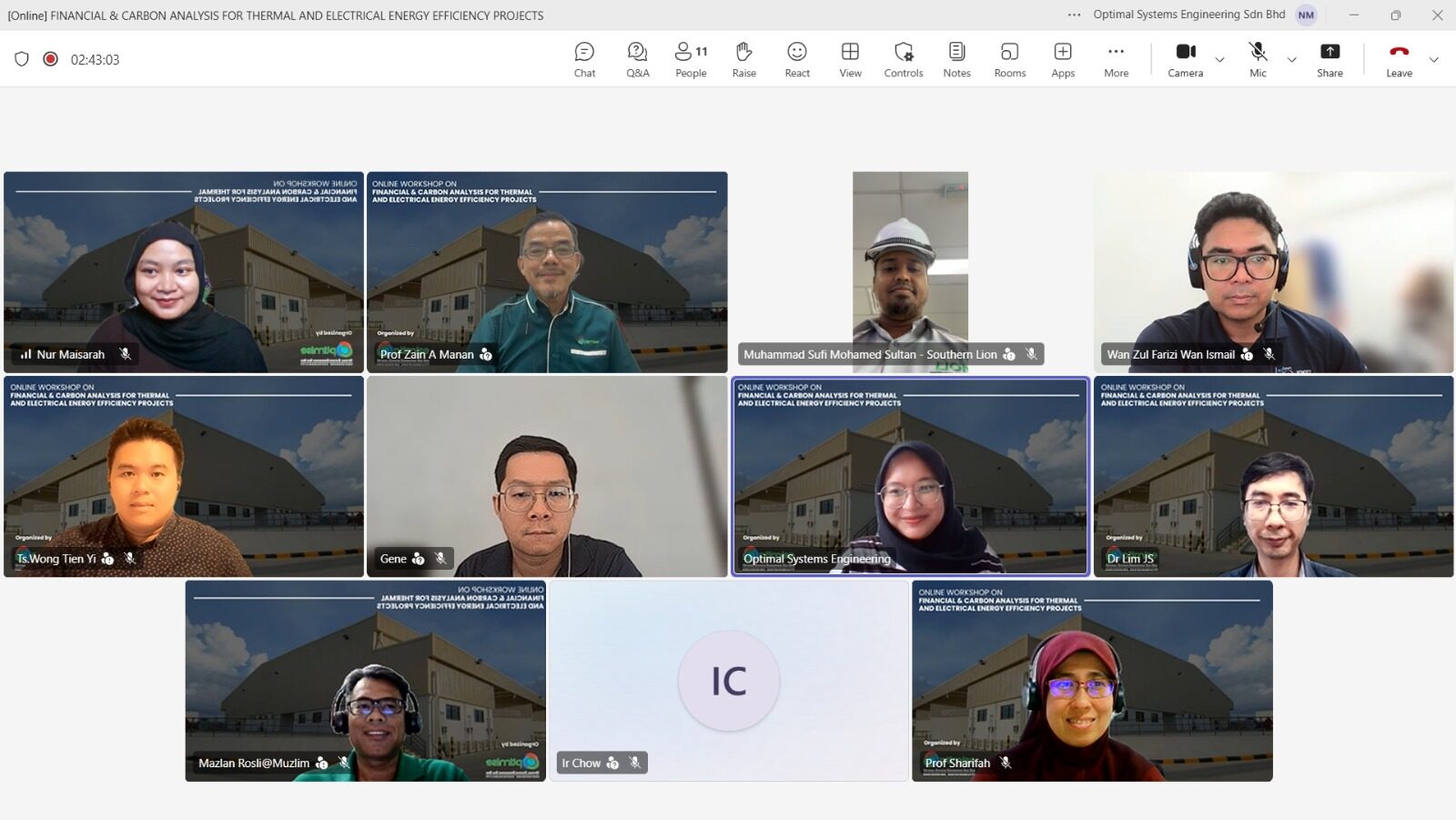
Optimal Systems Engineering Sdn Bhd (OPTIMISE) successfully concluded its 2-Day Workshop on Financial & Carbon Analysis for Thermal and Electrical Energy Efficiency Projects, held online via Microsoft Teams on 7–8 July 2026. Carrying 16 CDP hours and recognised as a mandatory programme for REM Type 1, the workshop was designed to help energy professionals transform technical energy-saving opportunities into credible, financially sound, and management-ready investment proposals.
As organisations place greater emphasis on cost optimisation, carbon reduction, and sustainable growth, energy efficiency projects must be supported by more than technical calculations. They require clear financial justification, reliable cash-flow projections, and measurable carbon benefits to compete effectively with other capital investments.
Responding to this industry need, the workshop equipped participants with practical skills to evaluate and communicate the commercial and environmental value of electrical and thermal energy efficiency projects. Through guided Excel exercises, real industrial examples, demonstrations, and case-based discussions, participants learned how to quantify energy savings, calculate financial returns, and present compelling project recommendations to management.
Turning Technical Opportunities into Strong Business Cases
The programme introduced participants to essential financial evaluation methods, including:
- Simple and Discounted Payback Period
- Return on Investment
- Net Present Value
- Internal Rate of Return
- Benefit-Cost Ratio
- Savings-to-Investment Ratio
- Life Cycle Costing
These tools enabled participants to move beyond basic savings estimates and develop more comprehensive assessments that consider capital expenditure, operating costs, energy price escalation, discounting, equipment replacement, and project lifetime performance.
Participants also explored electricity tariff structures, maximum-demand charges, and thermal fuel pricing for natural gas, diesel, and LPG. This knowledge is essential for producing accurate savings calculations and avoiding unrealistic financial projections.
Integrating Carbon Value into Investment Decisions
A key feature of the workshop was the integration of carbon economics into conventional financial analysis. Participants were introduced to internal carbon pricing, carbon-adjusted Net Present Value, carbon abatement costing, and Marginal Abatement Cost Curves.
These modern decision-making tools help organisations prioritise projects that deliver both financial returns and meaningful emissions reductions. Applications covered electrical systems such as motors, variable-speed drives, air-conditioning, and lighting, as well as thermal systems including boilers, steam networks, insulation, and heat recovery.
The programme progressed systematically from energy and cost savings, utility tariffs, and cash-flow modelling on the first day to Life Cycle Costing, carbon economics, sensitivity analysis, and investment decision-making on the second day. A comprehensive case study allowed participants to consolidate their learning and apply the methods in an integrated project assessment.
Practical Learning That Participants Can Apply Immediately
Participant feedback highlighted the relevance, practicality, and effectiveness of the workshop:
“Good practical exercises.”
“Very useful training to implement in current organisation, especially for project improvement priority.”
“Good practical use cases.”
“Great knowledge sharing, and the worksheet is functional.”
“On multiple occasions, I have not been disappointed and have always been pleasantly surprised. Each time I attend a training programme organised by the trainer, I gain new information that is aligned with global trends and more advanced.”
The feedback reflects the programme’s strong emphasis on practical application. Participants left with useful analytical tools, functional worksheets, and greater confidence in evaluating, prioritising, and presenting energy efficiency investments.
By combining engineering analysis, financial modelling, and carbon evaluation, the workshop strengthened participants’ ability to turn energy-saving ideas into strategic investment proposals, supporting lower operating costs, improved energy performance, and long-term organisational sustainability.