
 Share
Share
“Is this mandatory?”
“Is this just Government policy?”
“Do we have to follow the guideline?”
“What is the difference between the Act and the Regulation?”
These questions arise frequently whenever a new piece of legislation affects an industry.
And the confusion is understandable.
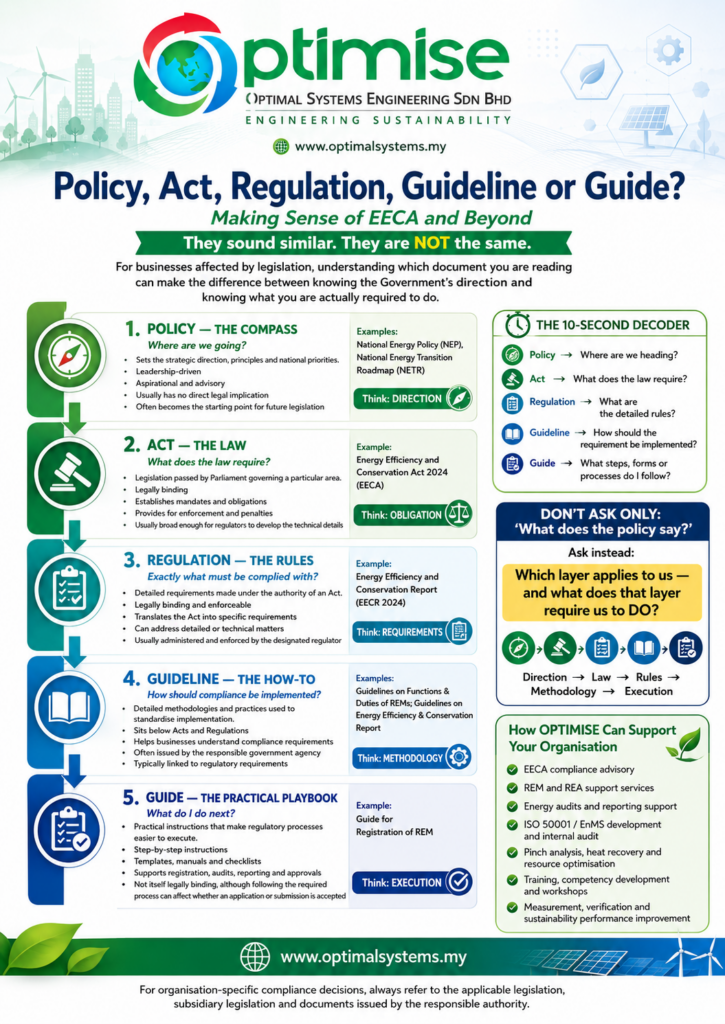
Policy, Act, Regulation, Guideline and Guide are often discussed together, but they do very different jobs.
For businesses, knowing the difference is more than an academic exercise. It helps management understand where Government is heading, what the law requires, how compliance will be assessed, and what the organisation needs to do next.
Start with the Policy: it tells us the direction
A Policy is best thought of as a compass.
It establishes strategic goals, priorities and principles. A roadmap may then translate that policy into actions, timelines and milestones.
In Malaysia’s energy landscape, the National Energy Policy (NEP) and National Energy Transition Roadmap (NETR) are useful examples.
Policies are generally leadership-driven and aspirational. They communicate direction, but they do not by themselves necessarily create legal obligations.
Importantly, however, today’s policy can become the foundation for tomorrow’s legislation.
So industry should never ignore policy simply because it is not yet law.
Policy tells you where the country is going.
The Act changes the conversation
An Act is legislation passed by Parliament.
This is where strategic intention becomes law.
An Act establishes the legal framework, obligations, powers of enforcement and, where applicable, penalties for non-compliance.
The Energy Efficiency and Conservation Act 2024 (EECA) is an example.
Acts are usually broader than the detailed rules needed for day-to-day implementation. Parliament establishes the legal framework, while more specific technical matters can subsequently be addressed through Regulations.
The Act tells you what the law requires.
Regulations provide the detailed rules
A Regulation sits under the authority of an Act and deals with more specific requirements.
This is where organisations are likely to encounter the operational and technical details needed for compliance.
Regulations are also legally binding and enforceable.
Examples from the energy sector is the Efficient Management of Electrical Energy Regulation (EMEER 2008) and Energy Efficiency and Conservation Regulation (EECR 2024)
The distinction matters.
An Act may establish the obligation.
A Regulation tells you much more specifically how that obligation is regulated.
Regulations turn the law into detailed requirements.
Guidelines explain the “how”
Then come Guidelines.
Guidelines provide detailed methodologies, practices and implementation expectations. They help organisations translate legislative and regulatory requirements into something that can be applied consistently.
For businesses, this is often where compliance begins to feel practical.
Examples include guidelines dealing with the functions and duties of Registered Energy Managers (REMs) and Energy Efficiency & Conservation Reports.
Because such Guidelines may be linked directly to regulatory requirements, organisations should not dismiss them simply because the document is called a “guideline”.
Guidelines explain how compliance should be implemented.
Guides take us from understanding to execution
Finally, there are Guides.
A Guide is the practical playbook.
It may contain:
- step-by-step procedures,
- registration instructions,
- templates,
- manuals,
- checklists,
- audit processes, and
- reporting procedures.
Unlike an Act or Regulation, the Guide itself is presented as not legally binding. But that does not make it irrelevant.
If a regulator prescribes a process for registration, submission or approval, an organisation still needs to understand and follow that process if it wants the application or submission to proceed successfully.
A Guide tells you what to do next.
One simple way to remember all five
Think of the regulatory landscape as a journey:
POLICY → Direction
ACT → Law
REGULATION → Detailed rules
GUIDELINE → Implementation methodology
GUIDE → Practical execution
This distinction becomes especially important when new legislation is introduced.
Management should not stop at:
“Have we read the new Act?”
The more useful questions are:
Which Regulations apply to us?
Which Guidelines determine how we demonstrate compliance?
Which Guides, forms, procedures and processes must our teams follow?
That is when an organisation moves from merely being aware of legislation to being ready for compliance.
For industries affected by energy legislation, regulatory literacy is quickly becoming a management capability in its own right.
Because understanding where a requirement comes from is the first step towards understanding what your organisation needs to do about it.