 Share
Share
What Organisations Need to Know Before the Anticipated EECA Notices
The Energy Efficiency & Conservation Act 2024 (EECA 2024) is now in force. Organisations exceeding the pThe Energy Efficiency & Conservation Act 2024 (EECA 2024) is now in force. Organisations exceeding the prescribed energy-consumption threshold are anxiously awaiting to receive an official Energy Consumer Notice from the Energy Commission (EC) that will formally trigger mandatory compliance obligations.
While most organisations are aware of the threshold requirement, far fewer realise that certain types and conditions of energy use may be excluded from the threshold calculation. Understanding what doesn’t count, and therefore, should be deducted from your total energy consumption could make a critical difference in determining whether or not your company needs to comply with EECA 2024.
In this sharing, we outline scenarios under which an organisation qualifies as an Energy Consumer, as well as key situations where certain energy uses may be excluded from the total energy input. Such exclusions may reduce overall energy consumption, potentially bringing a facility below the EECA Energy Consumer threshold. We also share over 30 frequently asked questions (FAQs) compiled from our ongoing engagement with stakeholders.
1. What Counts in The Threshold
If your organisation’s combined annual consumption of electrical and thermal energy reaches or exceeds 21,600 GJ, it is classified as an Energy Consumer under EECA 2024.
This includes purchased energy such as electricity, gas, steam, and chilled water, as well as non-renewable energy resources such asnatural gas, coal, LPG, and renewable sources like solar, biomass and hydro. All energy forms must be converted to GJ using the coefficients specified in the Energy Commission’s Guideline for Ascertaining Energy Consumer.
2. Scenarios that make your organisation an Energy Consumer1
Scenario A: You operate a single high-consumption facility
If your manufacturing plant, shopping mall, hotel, factory or commercial complex crosses the 21,600 GJ threshold, you are automatically in scope.
Scenario B: Multiple related organisations in the same compound
Two or more facilities owned by related corporations and operating within the same compound, but receiving separate energy supplies from a Public Installation Licensee (PIL), are treated by default as separate energy consumers, provided each facility independently exceeds the prescribed threshold.
However, they may apply to have their energy consumption aggregated and treated as a single energy consumer. If the combined total exceeds 21,600 GJ, the group is treated as one Energy Consumer.
For guidance on whether aggregation is advisable, please refer to our FAQ – Section 1, Q6.
Scenario C: Organisations located in different compounds are treated individually.
Facilities of related organisations located on separate land parcels or physically separated by other properties are treated individually. A facility qualifies as an Energy Consumer only if it independently exceeds the prescribed threshold.
3. Exclusions that do NOT count toward the threshold.
Deduct the following from your calculations:
- Onward sale/distribution of energy. An energy reseller (a PIL) is considered an Energy Consumer only if its net energy consumption (NEC) exceeds the threshold.
- NEC = Energy received − Energy sold to consumers or tenantswithout energy conversion
- Refer to our FAQ for specific NEC scenarios involving cases with and without energy conversion. FAQ – Section 1, Q6
- Energy-resources used as feedstock (e.g., natural gas used in syngas production for hydrogen is excluded, as it is classified as non-energy use)
These reductions may affect whether you cross the threshold.
4. What happens if you exceed the threshold?
If you exceed the threshold, you will be classified as an Energy Consumer and can expect to receive a notice from the Energy Commission. Your organisation will then be required to:
- Appoint a Registered Energy Manager (REM)
- Establish an Energy Management System (EnMS)
- Maintain detailed measurement and verification of consumption
- Undergo energy audits when required
Non-compliance may result in significant penalties.
5. What you must do NOW (Call to Action)
Immediate Checks
- Measure your past 12 months of energy use (convert to GJ).
- Identify all measuring points (electricity, gas, steam, chilled water).
- Determine whether facilities in the same compound should be grouped.
- Deduct excluded energy (feedstock + onward sales).
If you are near or above 21,600 GJ
Consider 7-Steps to prepare for EECA compliance before notices arrive.
6. Final Message for All Organisations
If your business consumes significant energy; whether industrial, commercial or large retail – you may fall within the EECA threshold without realising it.
Act now. Review your energy consumption, plan ahead, and avoid being caught unprepared when Energy Consumer (EC) notifications commence.
To help you get started, join OPTIMISE’s one-day virtual workshop, Understanding EECA and Its Impacts on Organisations, in 17 March 2026. This session provides a practical deep dive into EECA 2024, its Regulations, Guidelines, and supporting guidance documents.
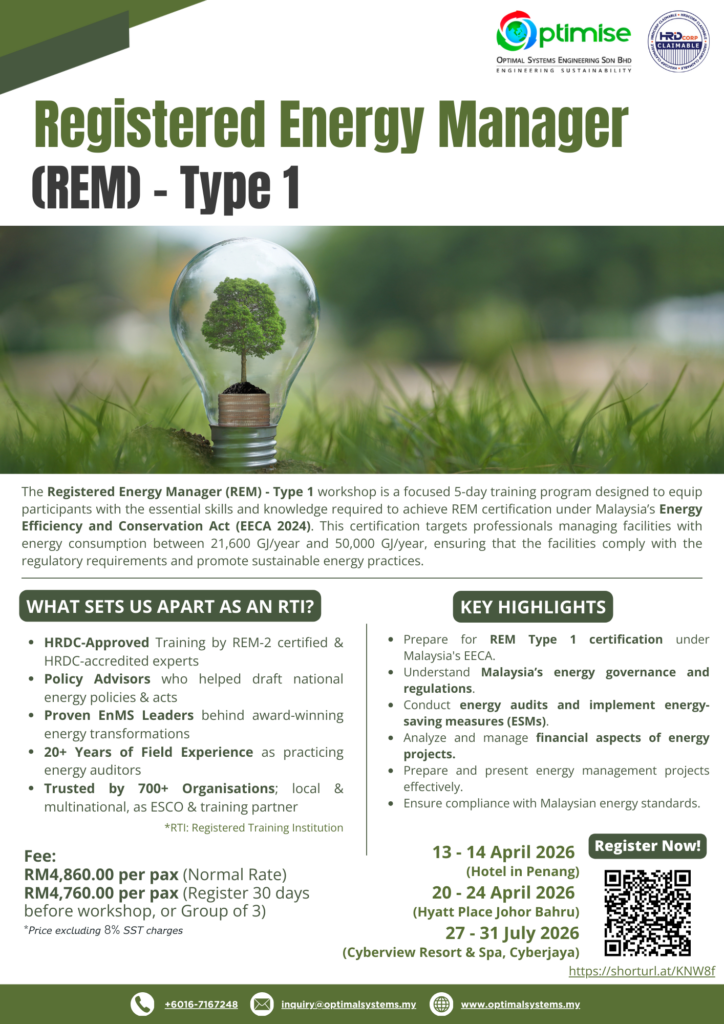
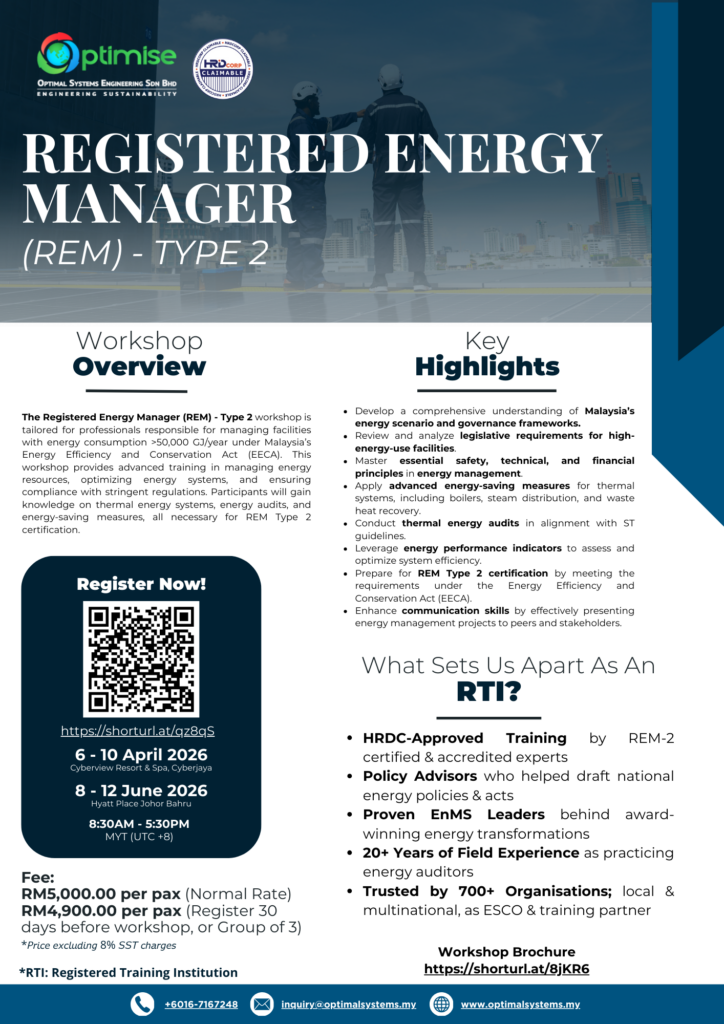
You may also consider attending OPTIMISE Registered Energy Manager (REM) Workshops as a pathway to becoming a Registered Energy Manager for your organisation.
- Reference: Guideline on Ascertaining Energy Consumer by the Energy Commission [GP/ST/No.44/2024] ↩︎