 Share
EECA 2024: 5 Reasons Why REM 1 Shouldn’t Wait to Begin REM 2 Training
One of the questions I have been asked repeatedly by newly registered energy managers and their employers is:
“Can a newly registered REM Type 1 attend REM Type 2 training immediately, or must they first complete one year as REM Type 1?”
I can understand the confusion.
Under the Energy Efficiency and Conservation Act (EECA) 2024 framework, a REM Type 1 is required to fulfil at least one year of service as REM Type 1 before becoming eligible to apply for REM Type 2 registration.
But here is the important distinction that many may have overlooked:
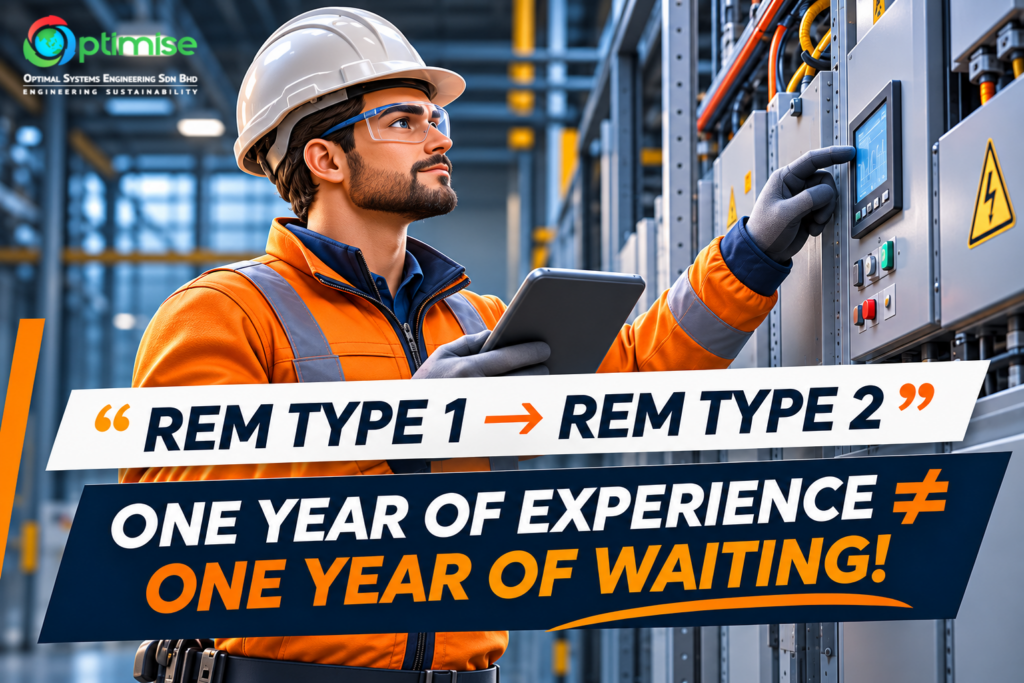
The one-year service requirement for REM Type 2 registration does not mean you must wait one year before attending REM Type 2 training!
In fact, there are five compelling reasons why REM Type 1 personnel and their employers should consider attending REM Type 2 training as early as possible.
1. Strike While the Knowledge Is Still Fresh!
Newly certified REM Type 1 personnel have a distinct learning advantage. Their knowledge of energy legislation, regulatory requirements and technical fundamentals is still fresh.
REM Type 2 training also revisits selected REM Type 1 topics, particularly energy legislation and essential technical knowledge, which remain relevant to the REM Type 2 assessment.
After all, the required competency in energy legislation is largely similar for both REM Type 1 and REM Type 2.
Why allow recently acquired knowledge to fade when you can build upon it?
2. Don’t Let One Year Turn Into Two!
This is perhaps the most overlooked practical consideration.
A REM Type 1 who waits until completing the one-year service requirement before enrolling in REM Type 2 training may face further delays arising from:
- Limited workshop availability or fully booked training sessions.
- Conflicting work commitments and delays in employer approval.
- Training budget constraints.
- Waiting for assessment results.
- Possible reassessment, where necessary.
- Administrative processing of the REM Type 2 registration application.
What appears to be a straightforward one-year progression could therefore take considerably longer.
The smarter approach is to plan training early rather than allow avoidable delays to postpone career progression.
3. Apply Advanced Knowledge While Gaining Experience
REM Type 2 training should not be viewed merely as a gateway to higher-level registration.
It is also an opportunity to deepen technical knowledge and strengthen practical energy management competencies.
By attending early, REM Type 1 personnel can apply their newly acquired knowledge while accumulating the required practical experience.
This creates a valuable cycle of learning, application and continuous competency development.
4. For Employers, Delayed Competency Development Can Be Costly!
For organisations requiring REM Type 2 services, the implications go beyond individual career progression.
Delays in developing qualified in-house REM Type 2 personnel may mean prolonged dependence on externally appointed REM Type 2 services, with the associated costs.
Early training also supports workforce development, succession planning and stronger internal energy management capabilities.
Investing in your people early may save your organisation time and money later.
5. Identify Competency Gaps Before They Become Obstacles
Early exposure to REM Type 2 training helps participants recognise areas where their technical knowledge and practical competencies need further strengthening.
Rather than discovering these gaps after completing their one-year service requirement, they can use the intervening period to improve their readiness.
So, Should You Wait?
My advice to REM Type 1 personnel and their employers is simple:
Don’t confuse the eligibility requirement for REM Type 2 registration with the timing of REM Type 2 training.
The one-year service requirement must still be fulfilled, and candidates should ensure they meet the applicable assessment and registration requirements.
However, there is no need to postpone professional development unnecessarily.
Start learning early. Build competency progressively. Be ready when you become eligible.
At OPTIMISE (Optimal Systems Engineering Sdn Bhd), our REM Type 2 workshops are designed not only to support certification assessment, but also to strengthen the practical competencies required of energy management professionals under EECA 2024.
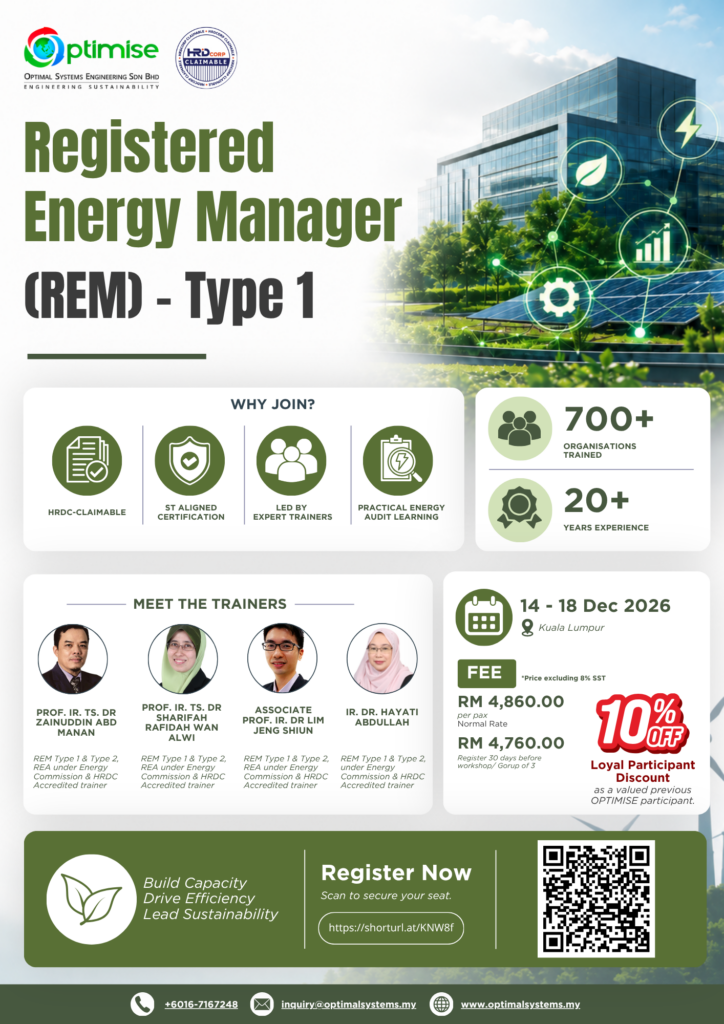
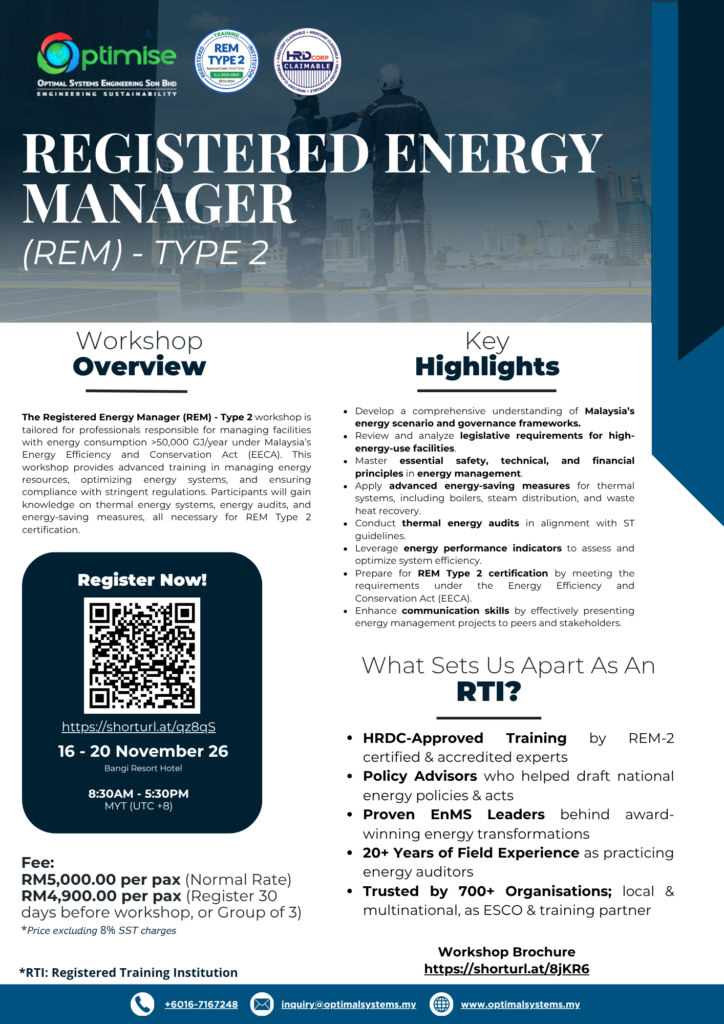
If you are a newly registered REM Type 1, or an employer planning to develop your in-house REM Type 2 capability, consider joining our upcoming REM Type 2 Certification Workshop.
Because good energy management begins with competent people – and developing competency should never be a last-minute exercise.
#EECA2024 #REMType1 #REMType2 #EnergyManagement #EnergyEfficiency #ProfessionalDevelopment #OPTIMISE